teTra aviation corp.

”Every time I fly, the countryside feels closer.”
―――What kind of future lies beyond these words?
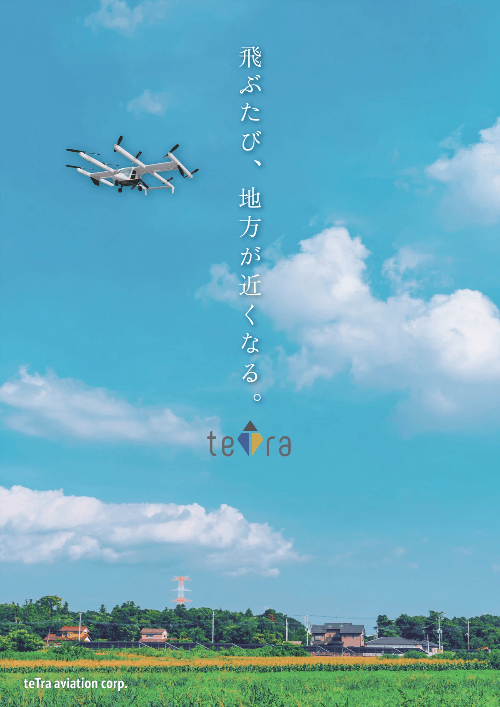
That is the vision of future mobility that Tetra Aviation is striving to achieve.
We view “flying cars” not merely as a technological innovation, but as a new form of social infrastructure that bridges the gap between rural and urban areas.
When the day comes that anyone can travel by air, we will not only be freed from the stress of traffic congestion,
but we will also be able to access hospitals, schools, and workplaces with greater freedom.
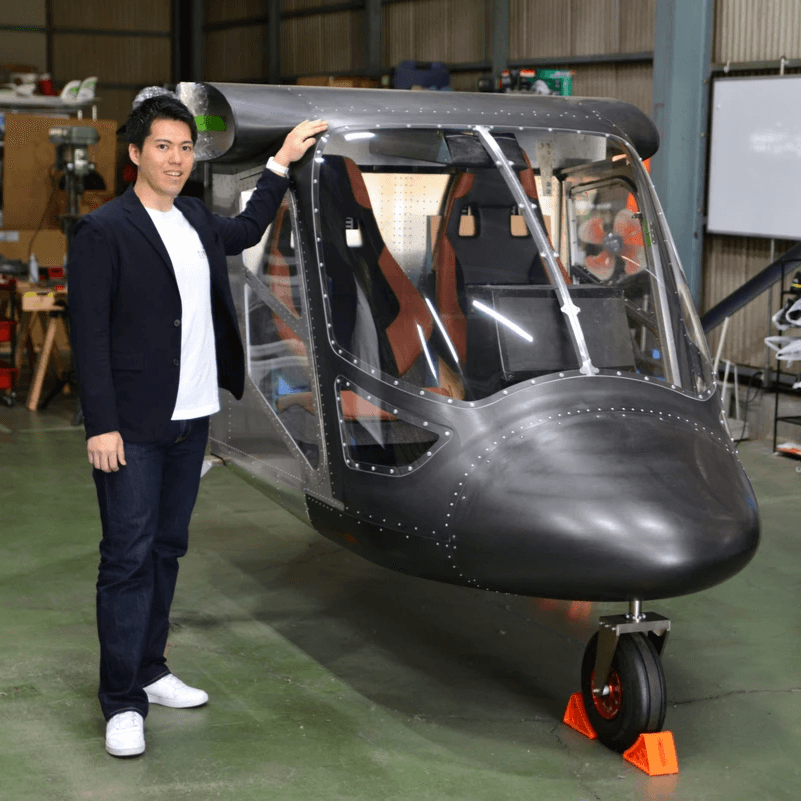
This vision began with a dream conceived by our founder, Nakai.
After our founding in 2018, we participated in “GoFly,” a competition for engineers from around the world, and achieved the remarkable feat of being the sole recipient of the Disruptive Technology Award.
Since then, we have been dedicated to developing a flying car capable of competing on the global stage.
We chose Minamisoma City in Fukushima Prefecture as the setting for this initiative.
Shortly after we launched our business, when a local resident asked us, “Will you expand your operations to Fukushima as well?” we answered “Yes” without hesitation.
The warm support we’ve received from the local community continues to be our driving force.
Currently under development in the skies above Fukushima, the next-generation “Mk-7” is a flying car nearing commercialization that can take off and land in very limited spaces.
This aircraft is set to usher in a new lifestyle that transcends the boundaries between urban and rural areas.
For example, imagine if a trip that currently takes two hours by car could be completed in just 15 minutes—
our lives and the way we work would be transformed from the ground up.
From Fukushima, to Japan, and to the world.
Travel by flying car will transform the future.
That is the challenge Tetra Aviation has set for itself.
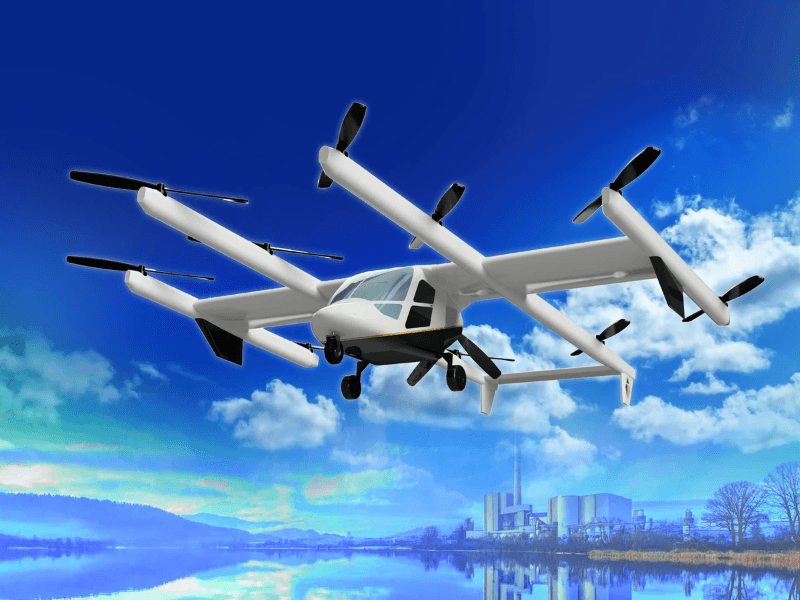
In December 2024, the company announced the “teTra Mk-7,”
a two-seater eVTOL with an extended range of up to 200 km.
In addition to prioritizing safety, the vehicle features an electric powertrain
that reduces carbon dioxide emissions, making it environmentally friendly,
and it also offers the flexibility to support unmanned operations in the future.
Through the development of models such as the Mk-3 and Mk-5,
we have laid the groundwork for the practical application of eVTOLs.
We believe that the Mk-7, a next-generation model that brings together all of these technologies and expertise,
will also contribute to solving social challenges such as revitalizing regional industries and
alleviating the concentration of population and resources in Tokyo.
We will continue to use Fukushima as a model case to share new forms of mobility with the world,
and we will keep striving to make a society where people can move freely through the air a reality.
"teTra Mk-7" Specifications
Crew: 2
Dimensions: Wingspan 8 m, Length 8 m, Height 2 m
Maximum takeoff weight: 1,500 kg
Range: 200 km (120 km)
Flight duration: 60 minutes (34 minutes)
Payload: 220 kg (140 kg)
Cruising speed: 259 km/h
*Specifications are estimated values; the figures in parentheses represent the
initial values at the start of service.
*Additionally, as a result of this, production and sales of the Mk-5 as a kit model
will be discontinued.